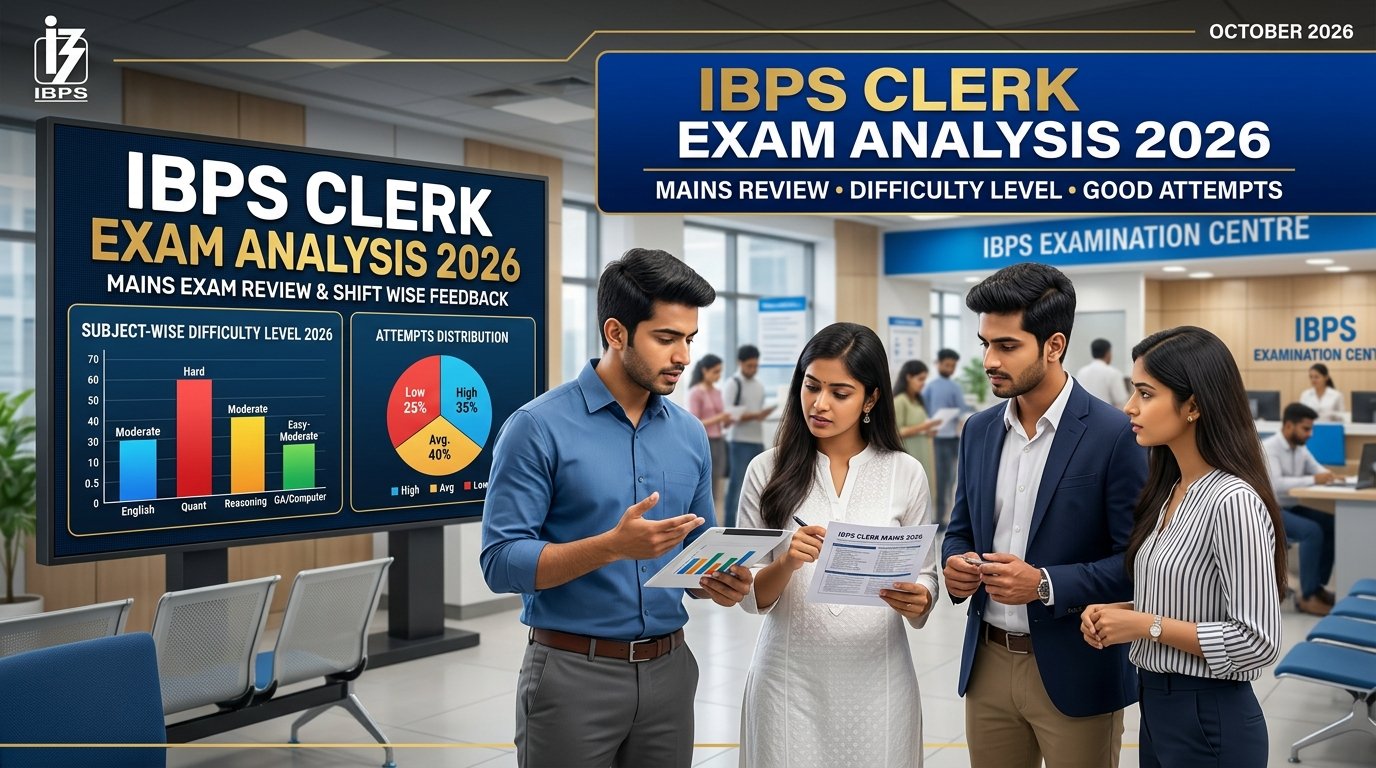
IBPS Clerk Prelims 2026 (CRP CSA XVI): 10 October All Shifts Review
Compiled by Yuva Result Editorial Team from real candidate interactions across pan-India examination centres.
The Institute of Banking Personnel Selection (IBPS) conducted Day 1 of the IBPS Clerk Preliminary Examination (CRP CSA XVI 2026) on 10 October 2026 across four shifts nationwide. This recruitment drive aims to fill 11,663 Customer Service Associate (Clerk) vacancies across 11 participating public sector banks.
Banking aspirants across India who appeared in Shift 1, Shift 2, Shift 3, and Shift 4 reported that the overall difficulty level of the paper remained in the Easy to Moderate spectrum. As expected, Reasoning Ability was the highest-scoring section, English Language was manageable with standard grammatical and comprehension questions, while Numerical Ability tested speed and accuracy due to calculation-heavy Data Interpretation sets and arithmetic word problems.
Below is the comprehensive shift-wise and section-wise exam analysis, question distributions, recommended good attempts, and strategic advice for candidates scheduled to appear in subsequent shifts on 11 October 2026.
IBPS Clerk Prelims 2026: Exam Highlights & Overview
| Particulars | Details |
|---|---|
| Exam Name | IBPS Clerk Prelims (CRP CSA XVI 2026) |
| Conducting Body | Institute of Banking Personnel Selection (IBPS) |
| Total Vacancies | 11,663 Posts |
| Post Designation | Customer Service Associate (Clerk) |
| Preliminary Exam Dates | 10 and 11 October 2026 |
| Mains Exam Date | 27 December 2026 |
| Exam Mode | Online Computer-Based Test (CBT) |
| Total Questions & Marks | 100 Questions / 100 Marks |
| Total Duration | 60 Minutes (Strict 20 Minutes per section) |
| Negative Marking | 0.25 Marks deducted per incorrect answer |
| Official Portal | ibps.in |
IBPS Clerk 10 October 2026: All Shifts Overall Review & Good Attempts
Below is the comparative performance and good attempts snapshot for all four shifts conducted on 10 October 2026:
| Shift | Exam Timing | Overall Difficulty | English (30) | Quant (35) | Reasoning (35) | Overall Good Attempts |
|---|---|---|---|---|---|---|
| Shift 1 | 09:00 AM – 10:00 AM | Easy to Moderate | 25–27 | 26–27 | 28–30 | 77–86 |
| Shift 2 | 11:30 AM – 12:30 PM | Easy to Moderate | 25–27 | 23–27 | 25–30 | 75–85 |
| Shift 3 | 02:00 PM – 03:00 PM | Moderate | 24–27 | 25–28 | 25–29 | 73–80 |
| Shift 4 | 04:30 PM – 05:30 PM | Easy to Moderate | 24–26 | 24–28 | 26–29 | 74–82 |
IBPS Clerk Exam Shift Timings & Reporting Schedule
Candidates must strictly follow the reporting schedule mentioned on their e-Admit Card. Entry gates close 15 minutes prior to exam commencement.
| Shift Slot | Reporting Time | Gate Closure Time | Exam Start Time | Exam End Time |
|---|---|---|---|---|
| Shift 1 (Morning) | 08:00 AM | 08:45 AM | 09:00 AM | 10:00 AM |
| Shift 2 (Mid-day) | 10:30 AM | 11:15 AM | 11:30 AM | 12:30 PM |
| Shift 3 (Afternoon) | 01:00 PM | 01:45 PM | 02:00 PM | 03:00 PM |
| Shift 4 (Evening) | 03:30 PM | 04:15 PM | 04:30 PM | 05:30 PM |
IBPS Clerk Prelims 2026 Exam Pattern & Section Order
The online test interface followed the standard IBPS sequence: English Language was presented first, followed by Numerical Ability, and finally Reasoning Ability.
| Section (Order) | Questions | Max Marks | Sectional Timing | Medium of Exam |
|---|---|---|---|---|
| 1. English Language | 30 | 30 | 20 Minutes | English |
| 2. Numerical Ability | 35 | 35 | 20 Minutes | Bilingual (English / Hindi / Regional) |
| 3. Reasoning Ability | 35 | 35 | 20 Minutes | Bilingual (English / Hindi / Regional) |
| Composite Total | 100 | 100 | 60 Minutes | Negative: 0.25 Mark |
IBPS Clerk Shift 1 Exam Analysis 2026 (10 October)
Shift 1 began at 09:00 AM. Aspirants reported that the paper was very well balanced. Reasoning was the smoothest section with 28–30 easily doable questions, while Numerical Ability was calculation-intensive due to caselets and multi-step word problems.
| Section | Questions | Difficulty Level | Good Attempts |
|---|---|---|---|
| English Language | 30 | Easy to Moderate | 25–27 |
| Numerical Ability | 35 | Easy to Moderate | 26–27 |
| Reasoning Ability | 35 | Easy to Moderate | 28–30 |
| Composite Overall | 100 | Easy to Moderate | 77–86 |
Shift 1 Reasoning Ability: Topic-wise Distribution
Reasoning had three puzzle & seating sets (15 questions). Candidates who quickly navigated single-question items and Chinese coding saved plenty of time for arrangement puzzles.
| Topic / Category | Number of Questions | Difficulty Level |
|---|---|---|
| Floor-Based Puzzle (7 Floors) | 5–6 | Moderate |
| Parallel Row Seating Arrangement | 4–5 | Easy to Moderate |
| Sequence-Based Puzzle (8 Persons) | 5–6 | Moderate |
| Chinese Coding (Substitution) | 5–6 | Easy |
| Digit + Symbol Alphanumeric Series | 5–6 | Easy to Moderate |
| Inequality (Direct Non-Comma) | 4 | Easy |
| Direction and Distance Sense | 3–4 | Easy to Moderate |
| Miscellaneous (Pair Formation, Meaningful Word, Odd One Out) | 3–4 | Easy |
| Total Reasoning Questions | 35 | Easy to Moderate (Good Attempt: 28–30) |
Shift 1 Numerical Ability: Topic-wise Distribution
Numerical Ability had 15 questions from Data Interpretation and Caselets. Candidates who executed quick mental calculations on Simplification saved valuable time for arithmetic.
| Topic / Category | Number of Questions | Difficulty Level |
|---|---|---|
| Simplification / Approximation | 8–10 | Easy (Direct BODMAS) |
| Bar Graph Data Interpretation (DI) | 6 | Moderate (Calculation-based) |
| Table Data Interpretation (DI) | 4–6 | Easy to Moderate |
| Caselet DI (Two small paragraph sets: 3+2 Qs) | 6–7 | Moderate |
| Arithmetic Word Problems (Ages, SI/CI, Profit & Loss, Ratio, Time & Work) | 8–10 | Easy to Moderate |
| Total Quant Questions | 35 | Easy to Moderate (Good Attempt: 26–27) |
Shift 1 English Language: Topic-wise Distribution
English was rated Easy to Moderate. One-third of the section was governed by a 9–10 question Reading Comprehension passage.
| Topic / Category | Number of Questions | Difficulty Level |
|---|---|---|
| Reading Comprehension (Theme: Sustainable Living / Economy) | 9–10 | Easy to Moderate |
| Cloze Test | 5–6 | Easy |
| Word Swap | 5–6 | Moderate |
| Error Detection (Grammar Rules) | 3–5 | Easy to Moderate |
| Sentence Rearrangement (Para Jumbles) | 3–5 | Easy to Moderate |
| Word Usage / Vocabulary | 2–4 | Moderate |
| Total English Questions | 30 | Easy to Moderate (Good Attempt: 25–27) |
IBPS Clerk Shift 2 Exam Analysis 2026 (10 October)
The second shift was conducted from 11:30 AM to 12:30 PM. Feedback showed that the level aligned closely with Shift 1. Quantitative Aptitude had slightly calculation-heavy DI sets, while Reasoning had straightforward syllogism and circular arrangement puzzles.
| Section | Questions | Difficulty Level | Good Attempts |
|---|---|---|---|
| English Language | 30 | Easy | 25–27 |
| Numerical Ability | 35 | Moderate (Lengthy DI) | 23–27 |
| Reasoning Ability | 35 | Easy to Moderate | 25–30 |
| Shift 2 Total | 100 | Easy to Moderate | 75–85 |
- Reasoning Highlights: Circular Seating Arrangement (8 persons facing inside), Box Puzzle (7 boxes), Syllogism (Only a few format - 4 Qs), Blood Relations (3 Qs).
- Quant Highlights: 10 Simplification questions (Easy), Line Graph DI (5 Qs), Tabular DI (5 Qs), Missing Number Series (5 Qs), Arithmetic word problems (10 Qs).
- English Highlights: Reading Comprehension based on Environmental Conservation (9 Qs), Fill in the blanks (5 Qs), Word Swap (5 Qs), Sentence Improvement (4 Qs).
IBPS Clerk Shift 3 Exam Analysis 2026 (10 October)
Shift 3 took place from 02:00 PM to 03:00 PM. Candidates observed a slight rise in difficulty compared to the morning shift. Arithmetic word problems and a tricky Caselet DI required careful calculation, keeping good attempts in the 73–80 window.
| Section | Questions | Difficulty Level | Good Attempts |
|---|---|---|---|
| English Language | 30 | Moderate | 24–27 |
| Numerical Ability | 35 | Moderate | 25–28 |
| Reasoning Ability | 35 | Easy to Moderate | 25–29 |
| Shift 3 Total | 100 | Moderate | 73–80 |
- Reasoning Highlights: Uncertain Number Linear Seating (14 persons, 4 Qs), Month & Date Puzzle (8 persons, 4 months, 5 Qs), Designation Puzzle (5 Qs), Inequality (4 Qs).
- Quant Highlights: Missing Number Series (5 Qs), Pie Chart DI (5 Qs), Caselet DI (4 Qs), Simplification (10 Qs), Arithmetic word problems (11 Qs).
- English Highlights: Reading Comprehension on Education Technology (10 Qs), Cloze Test (6 Qs), Sentence Rearrangement (5 Qs), Error Detection (5 Qs).
IBPS Clerk Shift 4 Exam Analysis 2026 (10 October)
Shift 4 concluded at 05:30 PM. The final shift of Day 1 maintained a steady pattern identical to Shifts 1 and 2. Aspirants who maintained steady composure throughout the 20-minute sectional blocks scored well across the board.
| Section | Questions | Difficulty Level | Good Attempts |
|---|---|---|---|
| English Language | 30 | Easy to Moderate | 24–26 |
| Numerical Ability | 35 | Easy to Moderate | 24–28 |
| Reasoning Ability | 35 | Easy to Moderate | 26–29 |
| Shift 4 Total | 100 | Easy to Moderate | 74–82 |
- Reasoning Highlights: Flat & Floor Puzzle (3 floors, 2 flats, 5 Qs), Linear Single Row Facing North (7 persons, 5 Qs), Syllogism (3 Qs), Direction Test (3 Qs).
- Quant Highlights: Simplification (10 Qs), Bar Graph DI (5 Qs), Table DI (5 Qs), Wrong Number Series (5 Qs, Moderate), Arithmetic (10 Qs).
- English Highlights: Reading Comprehension (Story/Workplace Psychology, 9 Qs), Single Fillers (5 Qs), Word Swap (5 Qs), Error Detection (4 Qs).
Mathematical Reality Check: Why 90% Accuracy Wins Over 85+ Blind Attempts
Many aspirants make the fatal mistake of chasing high attempt counts through educated guesses. In IBPS Clerk Prelims, with a 0.25 negative marking penalty, accuracy directly dictates qualification:
Total Attempts: 80 questions
Correct: 72 | Wrong: 8 (90% accuracy)
Gross Marks: 72.00
Negative Penalty (8 × 0.25): -2.00
Net Normalised Score: 70.00 Marks
Result: High likelihood of clearing State Cutoff & qualifying for Mains.
Total Attempts: 86 questions
Correct: 68 | Wrong: 18 (79% accuracy)
Gross Marks: 68.00
Negative Penalty (18 × 0.25): -4.50
Net Normalised Score: 63.50 Marks
Result: In danger of missing state cutoffs in high-competition states.
IBPS Clerk 2026 Expected Cut-Off Trends & Normalisation Process
Unlike PO examinations where cutoffs are uniform across the nation, IBPS Clerk cutoffs are strictly declared State-wise and Category-wise because vacancies are allocated to specific states.
Factors Influencing the State-Wise Cutoff:
- State-Specific Vacancy Count: States with higher vacancies (e.g., Maharashtra, Uttar Pradesh, Gujarat) generally witness slightly lower cutoffs compared to states with fewer clerical seats (e.g., Delhi, Chandigarh, Kerala).
- Multi-Shift Normalisation: Because the exam is held across 8 shifts (4 shifts on 10 Oct + 4 shifts on 11 Oct), IBPS implements the Equi-Percentile Normalisation Method to balance minor variations in sectional difficulty across shifts.
- Expected Range for General/UR Category: Based on today's overall paper standard, expected cutoff scores across major circles are anticipated in the range of 71.00 to 79.50 marks.
Top 5 Golden Rules for Candidates Appearing on 11 October 2026
1. Target Simplification First
8 to 10 questions in Numerical Ability are standard Simplification. Finish them within 4–5 minutes to guarantee easy marks before touching DI.
2. Scan Reasoning Puzzles Quickly
Attempt inequality, Chinese coding, and alphanumeric series first. When approaching puzzles, select single-variable floor or row puzzles before tackling complex sequences.
3. Manage the 20-Minute Timer Strictly
Do not get stuck on a single arithmetic word problem or a stubborn puzzle for more than 2 minutes. Skip immediately and move ahead.
4. Zero Blind Guessing
Negative marks will drastically push you below state cutoffs. Attempt only questions where you are 100% sure of the logic.
Exam Day Mandatory Documents Checklist
Before leaving for your examination centre, ensure you have:
- Printed IBPS Clerk Admit Card (Call Letter): With a clear, recent passport-size photograph firmly pasted on the designated box.
- Original Photo ID Proof: (Aadhaar Card, PAN Card, Voter ID, Passport, or Driving License). Ration Card and Learner's License are NOT accepted.
- Photocopy of the same Photo ID: Stapled to the Admit Card.
- Two Additional Passport Photographs: Identical to the one uploaded during online registration.
- Simple Ballpoint Pen: (Blue or Black). Rough sheets will be provided inside the examination lab.