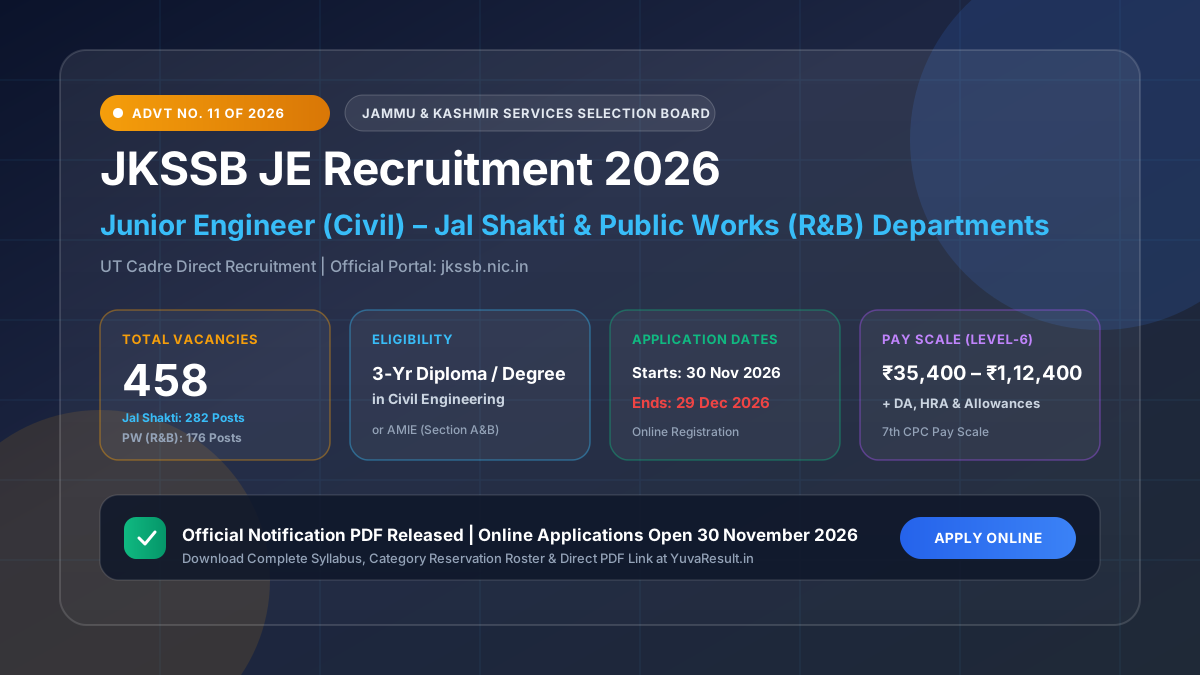
JKSSB Junior Engineer (Civil) Recruitment 2026: 458 UT Cadre Vacancies
⚡ Recruitment Summary: The Jammu & Kashmir Services Selection Board (JKSSB) has officially published Advertisement Notification No. 11 of 2026 inviting online applications for 458 Junior Engineer (Civil) vacancies. The recruitment is distributed across the Jal Shakti Department (282 Posts) and the Public Works (Roads & Buildings) Department (176 Posts) under UT Cadre. Online submissions open on 30 November 2026 and close on 29 December 2026 on jkssb.nic.in. Both 3-Year Polytechnic Diploma holders and B.E./B.Tech Civil Engineering graduates domiciled in J&K are eligible to apply.
100% Written Test Weightage: There is Zero Interview. The merit list is prepared strictly based on the performance in the 120-mark objective type written examination (CBT or OMR mode), followed by Document Verification.
UT Cadre Postings: Appointed candidates will serve across critical civil infrastructure projects, road connectivity, water treatment plants, and flood management networks across all districts of Jammu & Kashmir.
1. Departmental Scope: Jal Shakti Department vs Public Works (R&B)
Understanding the core operational responsibilities and project areas of appointed Civil Junior Engineers.
Junior Engineers (Civil) in the Union Territory of Jammu & Kashmir serve as frontline technical supervisors responsible for field measurements, bill verification, execution of engineering estimates, and quality assurance:
Jal Shakti Department (282 Posts)
Oversees the Public Health Engineering (PHE), Irrigation & Flood Control (I&FC), and Ground Water divisions. Engineers handle piped potable drinking water supply under Jal Jeevan Mission (JJM), canal network construction, dam spillway maintenance, riverbank embankment reinforcement, and flood spill channel desiltation across Kashmir and Jammu basins.
Public Works (R&B) Department (176 Posts)
Acts as the premier state infrastructure agency overseeing Roads & Buildings (R&B), bridges, government institutional complexes, district court premises, medical college buildings, and state highway maintenance. JEs supervise contractors, inspect asphalt concrete quality, check structural reinforcement, and verify contractor running bills.
2. J&K UT Domicile Mandate & Reservation Norms
Statutory domicile certificate directives and reservation categories under J&K Reservation Rules.
The recruitment is strictly reserved for bonafide residents holding a valid Domicile Certificate of the Union Territory of Jammu & Kashmir. Aspirants must take note of the following statutory guidelines:
- Cutoff Date for Domicile: The candidate must be in possession of a valid Domicile Certificate issued by the designated Competent Authority (Tehsildar) on or before the application cutoff date of 29 December 2026.
- Category Reservation Quotas: Reservation benefits apply to Scheduled Castes (SC), Scheduled Tribes (ST-1 & ST-2), Residents of Backward Area (RBA), Residents of Areas adjoining Actual Line of Control / International Border (ALC/IB), Economically Weaker Sections (EWS), and Other Backward Classes (OBC) as notified under the Jammu and Kashmir Reservation Rules.
- Horizontal Reservation: Persons with Benchmark Disabilities (PwBD) and Ex-Servicemen (ESM) receive horizontal reservation across all vertical categories as per Government rules.
3. Technical Civil Engineering Syllabus: Topic-Wise Analysis
Curriculum mapping for the 120-Mark objective test based on Diploma / Degree engineering curricula.
The 120 questions are distributed across core civil engineering disciplines. Candidates should prioritize high-yield modules:
Structural Engineering & RCC (30 Marks)
Covers stress-strain diagrams, Mohr's circle, shear force and bending moment diagrams for determinate beams, Euler's column formula, and limit state design of singly/doubly reinforced beams, one-way/two-way slabs, and retaining walls per IS 456:2000.
Fluid Mechanics & Irrigation Engineering (25 Marks)
Pascal's law, continuity equation, Bernoulli's theorem, laminar vs turbulent flows, Darcy-Weisbach equation, Lacey's and Kennedy's silt theories for canals, crop water requirements (duty, delta, base period), and gravity dam stability forces.
Soil Mechanics & Foundation Engineering (15 Marks)
Three-phase soil systems, grain size distribution, Atterberg limits, soil compaction and consolidation curves, direct shear and triaxial tests, Terzaghi's bearing capacity theory for shallow strip footings, and pile load capacities.
Surveying, Transportation & Estimating (50 Marks)
Two-peg test, magnetic declination, leveling reductions (Height of Instrument & Rise-and-Fall), stopping sight distance (SSD) and overtaking sight distance (OSD), super-elevation calculation on highway curves, rate analysis, and concrete mix design.
4. Career Hierarchy & Promotional Prospects for Junior Engineers
Long-term administrative and technical ladder in Jammu & Kashmir Engineering Gazetted Services.
Joining as a Junior Engineer (Level-6) offers prestigious progression into state gazetted engineering cadres through Departmental Promotion Committees (DPC) and eligibility quotas:
5. Exam Day Strategy: Negative Marking Mitigation & High-Score Roadmap
Actionable tactics to secure top ranks without losing marks to penalty deductions.
- Tackle 0.25 Negative Marking: Never resort to blind guessing. Each wrong answer erodes 0.25 marks, which significantly impacts rank when hundreds of candidates cluster within a 2-mark range.
- Time Management (120 Mins for 120 Qs): Aim for a 2-pass strategy. In the first 60 minutes, solve all direct formula-based and factual questions. Reserve the second hour for numerical problems in structural mechanics and surveying.
- IS Code Knowledge: Thoroughly review Indian Standard provisions, notably IS 456 (Plain and Reinforced Concrete), IS 800 (General Construction in Steel), and IS 1343 (Prestressed Concrete), as direct codal specification questions appear frequently.